The "Nice" Team Trap: Why Politeness is Killing Your Team’s Productivity 「好人團隊」陷阱:為何過分客氣正在拖垮團隊的生產力?
We have all worked on a team that felt incredibly pleasant. Everyone smiles, birthdays are celebrated with enthusiasm, and conflict is virtually non-existent. On paper, it looks like a dream culture.
But behind the scenes, projects lag, deadlines are missed with a gentle shrug, and nobody feels comfortable pointing out.
When introducing the Team Psychological Safety International Certification Program, one of the very first misconceptions we tackle is this: Psychological safety is not about being nice. In fact, confusing politeness with safety is one of the most common reasons culture initiatives fail.
The High-Performance Team Matrix
To truly understand how team dynamics drive results, our certification program maps teams across two critical axes: Positivity and Productivity.
When we plot these, we see four distinct team environments. Take a look at where your team might fall:
Low Positivity / Low Productivity (The Toxic Zone): Characterized by criticism, blame, cynicism, and turf protection. It feels like "one step forward, two steps back."
Low Positivity / High Productivity (The Burnout Zone): A "Just Do It!" culture. While driven and competitive, it suffers from high turnover, guarded communication, and imminent burnout.
High Positivity / Low Productivity (The "Nice" Trap): This is the collegial, friendship-based environment where incompetence is tolerated to avoid "rocking the boat." There is a sense of connection, but an insufficient sense of urgency.
High Positivity / High Productivity (The Sweet Spot): The ultimate goal. This is a successful, fun environment where challenging goals and inspiring visions meet open communication and proactive change.
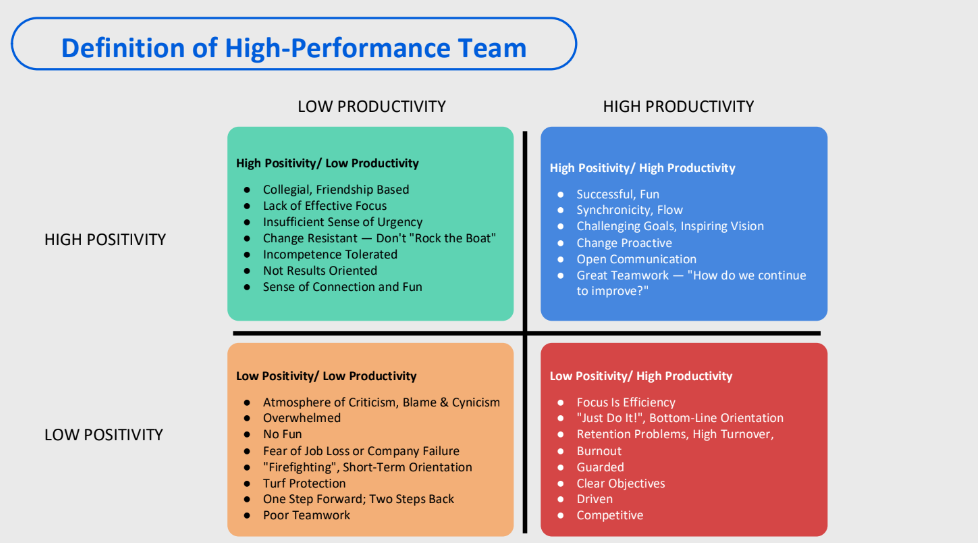
The ultimate goal of our certification program is to give leaders the practical tools to move their teams out of the stagnant "Nice" trap and into the high-performing High Positivity / High Productivity quadrant.
Why "Nice" is the Enemy of "High Performance"
In a purely "nice" culture (High Positivity / Low Productivity), people prioritize comfort over candor. When someone misses a deadline or submits subpar work, colleagues stay silent because they don’t want to hurt feelings. This lack of effective focus creates a culture where results take a backseat to social harmony.
True psychological safety is the exact opposite. It isn't a soft, cozy blanket; it is the infrastructure that allows for fierce, unfiltered debate.
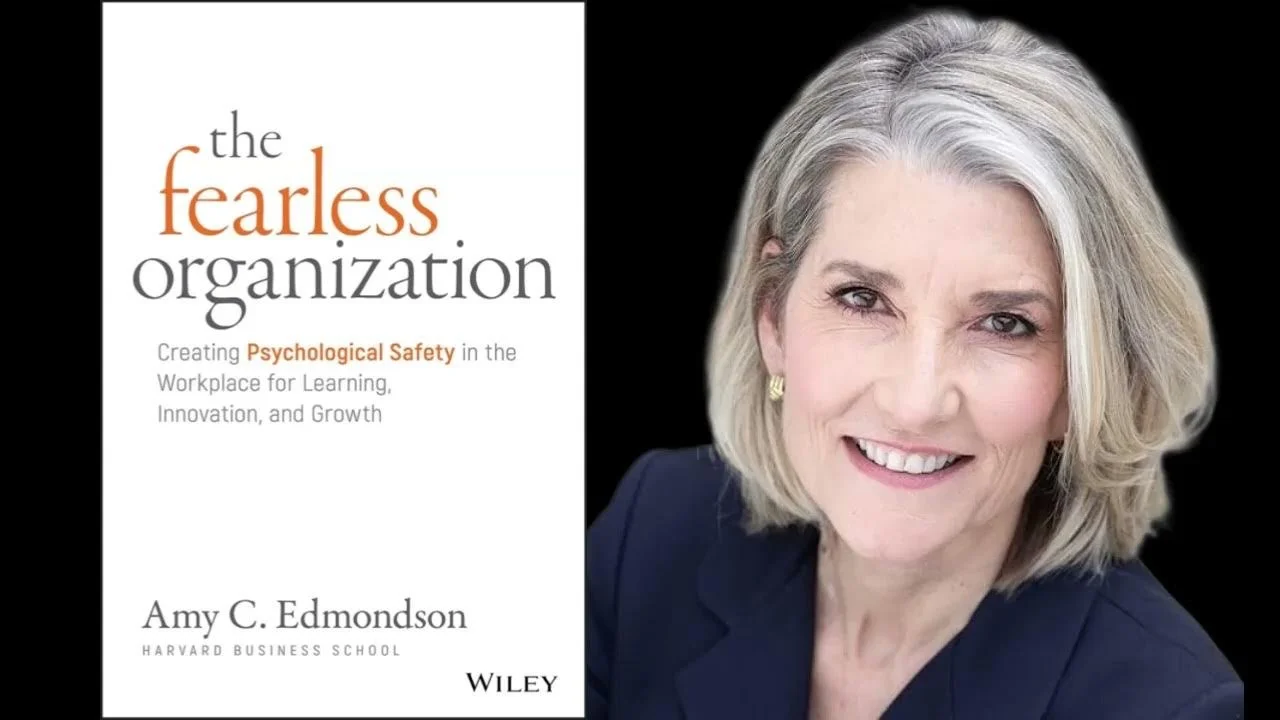
As Harvard Business School Professor Amy Edmondson explains in The Fearless Organization, psychological safety is not about being nice — it is about admitting mistakes, and learning from one another.
When a team has high psychological safety, they have the high positivity required to trust one another, which unlocks the high productivity required to smash goals. They can challenge ideas aggressively without challenging the person's value.
3 Ways to Shift from "Polite" to "Productively Safe"
If your team is stuck in the friendship-based, low-productivity zone, here are three micro-habits we teach in our certification course to start shifting the needle:
Reframe Conflict as Collaboration: Explicitly tell your team that disagreement is a sign of engagement, not disrespect.
Normalize "Intelligent Failure": Celebrate when someone admits a mistake early. It prevents the "firefighting" mentality later on.
Replace "Does everyone agree?" with "What am I missing?": The first question invites polite nods; the second actively invites diverse perspectives.
Ready to Transform Your Team Culture?
Building a high-positivity, high-productivity team isn’t accidental—it’s a science.
If you are ready to move past surface-level politeness and build a truly fearless, high-performing organization, join us for the next cohort of the Team Psychological Safety International Certification Program. Learn the frameworks, master the metrics, and become the leader your team truly needs.
Latest News! Upcoming Cohorts Now Accepts Registration:
Cohort #5 (English)
💻 June 15, 22, 29, and July 6, 2026 (Mondays 9:30AM-12:30PM) – Online sessions
Cohort #6 (Cantonese)
📍8 August 2026 (Saturday 9:30AM-5:30PM)– In-person
💻15 & 22 August 2026 (Saturday 9:30AM-12:30PM) – Online sessions
「好人團隊」陷阱:為何過分客氣正在拖垮團隊的生產力?
我們大概都曾置身於某些「氣氛融洽」的團隊。同事之間笑容滿面,生日派對辦得熱鬧非凡,幾乎從未發生爭執。表面看來,這簡直是夢寐以求的團隊文化。
然而在幕後,項目進度卻一拖再拖,期限過了大家輕輕聳肩便算,而最關鍵的問題——無人敢於指出。
當我們推出「團隊心理安全國際認證課程」(Team Psychological Safety International Certification Program)時,首先要拆解的誤解便是:心理安全並不等同於做好人。事實上,將「客氣」誤當作「安全」,正是眾多企業文化改革失敗的最常見原因。
高效團隊
要真正理解團隊動態如何影響成效,本認證課程會以兩條關鍵軸線分析團隊:正向氣氛與生產力。
將兩者一併分析,便能呈現出四種截然不同的團隊環境。不妨思考一下,您的團隊屬於哪一類:
低正向/低生產力(毒性區):充斥批評、指責、犬儒態度與部門山頭主義,永遠停留在「進一步、退兩步」的困境。
低正向/高生產力(過勞區):典型的「總之做就對了」文化。儘管鬥志旺盛、競爭激烈,卻面臨人員流失率高、溝通處處設防,距離全面崩潰僅一步之遙。
高正向/低生產力(「好人」陷阱):以人情為先的職場環境,為了避免破壞氣氛,即使同事表現未達標準,也選擇視而不見。團隊有歸屬感,卻嚴重缺乏緊迫感。
高正向/高生產力(黃金地帶):終極目標。一個既愉快又成功的環境,富挑戰性的目標與鼓舞人心的願景,與開放溝通和積極求變的文化相輔相成。
本認證課程的核心目標,正是為管理者提供實用工具,協助他們帶領團隊脫離停滯不前的「好人」陷阱,邁向「高正向/高生產力」的黃金地帶。
為何「做好人」是「高效能」的頭號敵人?
在純粹的「好人」文化(高正向/低生產力)之中,人們往往將個人舒適置於坦誠之上。當有人錯過期限或交出未達標的工作,同事們選擇沉默,只因不願傷害感情。這種欠缺有效焦點的氛圍,造就了一種以社交和諧為先、成果反退居其次的文化。
真正的心理安全,恰恰與此相反。它並非一張柔軟舒適的毛毯,而是支撐團隊進行激烈、毫無保留辯論的基礎架構。正如哈佛商學院教授 Amy Edmondson 一語中的:
「心理安全並非做好人,而是關於坦誠回饋、承認錯誤,以及彼此學習。」The Fearless Organization by Professor Amy Edmondson
當團隊擁有高度心理安全感時,便能憑藉充足的正向氣氛建立互信,從而釋放出達成目標所需的高生產力。他們可以毫不留情地挑戰意見,卻無損提出意見者的個人價值。
從「客氣」邁向「安全又高效」的三個方法
倘若您的團隊正困於「人情至上、生產力低落」的區域,以下是本認證課程所傳授的三個微小習慣,有助您逐步扭轉局面:
一、將「衝突」重新定義為「協作」:明確告知團隊,意見分歧代表投入,而非不敬。
二、讓「聰明的失敗」成為常態:當有人及早承認錯誤時,公開予以肯定,從而避免日後演變成「處處救火」的被動局面。
三、以「我有什麼遺漏?」取代「大家都同意嗎?」:前者只會換來禮貌的點頭,後者則能主動邀請多元觀點。
準備好改變團隊文化了嗎?
打造「高正向、高生產力」的團隊絕非偶然,而是一門科學。
若您已準備好擺脫流於表面的客套文化,建立一個真正無畏、高效能的組織,誠邀您加入下一期的團隊心理安全國際認證課程。掌握實戰框架、精通評估指標,成為團隊真正所需的領導者。
準備好革新您的團隊文化了嗎?
打造一支「高正向、高生產力」的團隊絕非偶然,而是一門科學。
若您已準備好擺脫流於表面的客套,建立一個真正無畏、高效能的組織,誠邀您加入下一期的團隊心理安全國際認證課程(Team Psychological Safety International Certification Program)。掌握實戰框架、精通評估指標,蛻變為團隊真正所需的領導者。
📢 最新消息!下期課程現正接受報名:
第五期(英文授課)
💻 2026年6月15日、22日、29日及7月6日(星期一,上午9:30至中午12:30)網上課堂
第六期(粵語授課)
📍 2026年8月8日(星期六,上午9:30至下午5:30)實體課堂
💻 2026年8月15日及22日(星期六,上午9:30至中午12:30)網上課堂