When top talent suddenly disengages or hands in their resignation, leadership teams often default to standard retention tactics: offering salary bumps, adjusting bonuses, or reviewing corporate perks.
However, data reveals a glaring reality—employees don't just leave bad jobs; they leave bad team dynamics.
According to a landmark study by The Five Behaviors (Wiley, 2021), 42% of respondents left their jobs due to poor team experiences. When collaboration breaks down and employees feel unsupported, talent walks out the door. The missing link in these organizations isn’t compensation—it is Team Psychological Safety.
The Hard Data: Psychological Safety vs. Workplace Burnout
A comprehensive 2024 study conducted by the American Psychological Association (APA) via The Harris Poll surveyed over 2,000 employed adults. The data provides undeniable proof that psychological safety directly dictates employee retention, mental health, and day-to-day performance.
The contrast between workplaces with high psychological safety and those without is staggering:
Retention and the Bottom Line
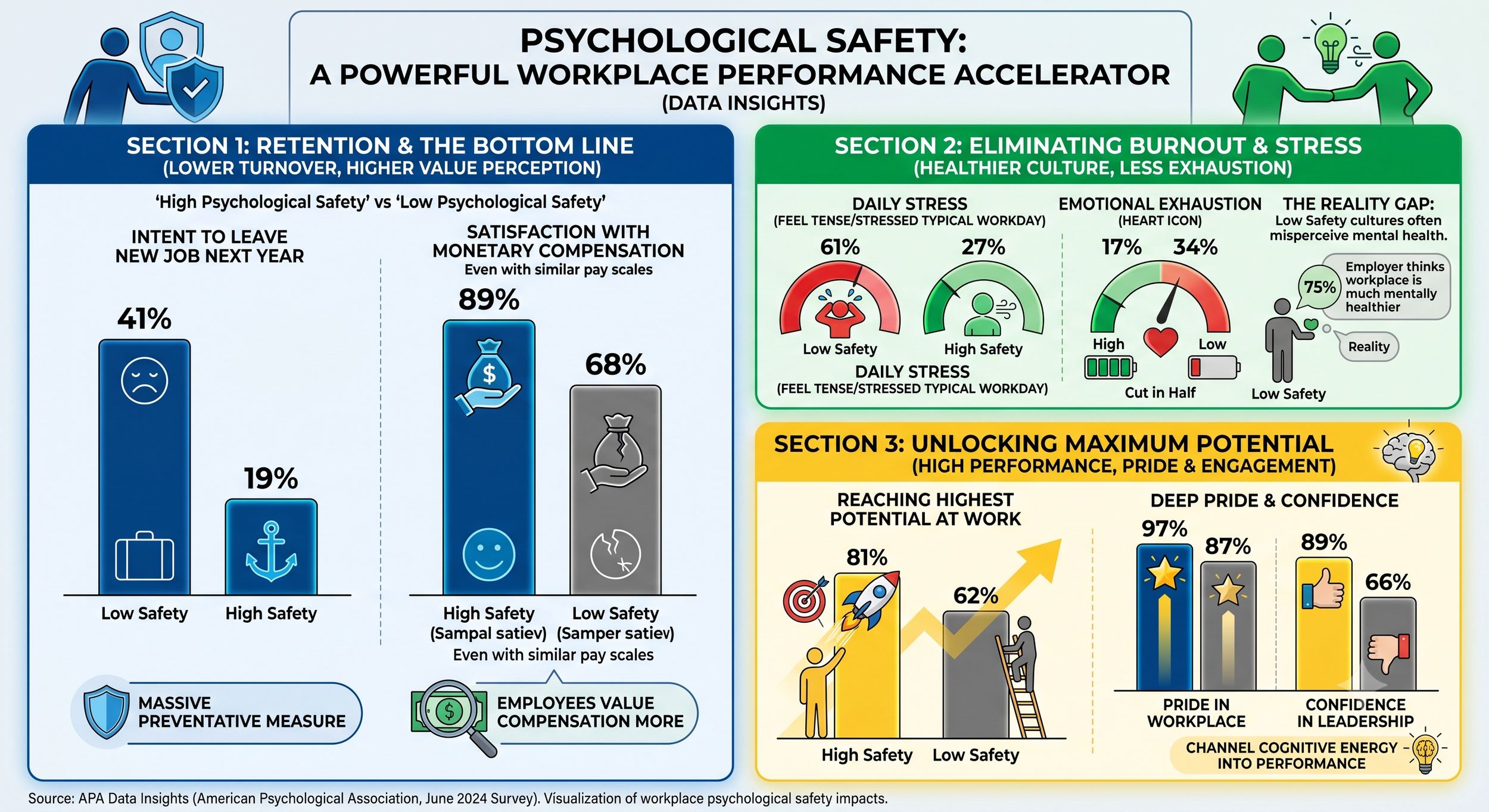
Replacing elite talent is expensive. The APA data highlights psychological safety as a massive preventative measure against turnover:
Intent to Leave: Only 19% of workers in highly psychologically safe environments intend to look for a new job in the next year, compared to a massive 41% in low-safety environments.
Compensation Perception: Fascinatingly, 89% of employees with high psychological safety report satisfaction with their monetary compensation, compared to just 68% of those with low safety—even when actual pay scales are similar. When people feel safe, they value their total compensation more.
Eliminating Burnout and Stress
Quiet quitting and emotional exhaustion are direct symptoms of a toxic or high-pressure, low-safety culture.
Daily Stress: 61% of workers in low-safety environments feel tense or stressed during a typical workday, compared to just 27% in psychologically safe teams.
Emotional Exhaustion: High psychological safety cuts emotional exhaustion squarely in half (17% vs. 34%).
The Reality Gap: In low-safety cultures, 75% of workers feel their employer mistakenly thinks the workplace is mentally healthier than it actually is.
Unlocking Maximum Potential
When employees aren't wasting cognitive energy protecting themselves from blame, they channel that energy into performance:
Reaching Potential: 81% of individuals experiencing high safety feel they can reach their highest potential at work, versus 62% in low-safety settings.
Meaning and Pride: Highly safe environments foster deep pride (97% vs. 87%) and immense confidence in organizational leadership (89% vs. 66%).
The Takeaway for HR and Team Leaders: Creating a work culture where team members can genuinely be themselves, speak up, challenge ideas, and take calculated risks isn't a "soft" HR initiative. It is a rigorous business strategy that directly impacts your bottom line.
Transform Your Leadership: Take the Next Step
To build high-performing teams that stay, leaders and HR professionals must learn to audit, measure, and implement concrete workplace practices that foster psychological safety.
1. Join Our Upcoming International Certificate Program
Equip yourself with global frameworks to measure and cultivate trust within your teams. Learn directly from Mônica, Hong Kong’s very first Master Facilitator of Team Psychological Safety.
Upcoming Cohort #5: Launches 15 June 2026 (Seats are filling quickly to finalize quotas)
June 15, 22, 29, and July 6, 2026 (Mondays 9:30AM-12:30PM) – Online sessions
Learn directly from Hong Kong’s master facilitators Leona Wan and Venus Leung:
Language: Cantonese supplemented with English materials
Upcoming Cohort #6 : Launches 5 August 2026📍8 August 2026 (Saturday 9:30AM-5:30PM)– In-person
💻15 & 22 August 2026 (Saturday 9:30AM-12:30PM) – Online sessions
2. Bring this Transformation In-House
Want to align your entire management layer? We offer customized In-House Training Programs tailored specifically to your organization’s structure, culture, and leadership goals.
👉 [Book a Consultation with Our Experts for In-House Training] - email to info@felizconsulting.com
為何香港高績效團隊開始「安靜離職」?
在香港這個高壓、高競爭的商業環境裡,企業最擔心的不是缺人才,而是——留不住核心人才。
當高績效員工開始「靜靜地 disengage」,只完成最低要求、不再主動、不再創新,很多管理層第一反應是:
是否要加薪?
是否要調整 Bonus?
是否福利不夠吸引?
但事實是——
員工離開的,往往不是工作,而是團隊文化。
數據不會說謊:心理安全感直接影響留任率與盈利能力
根據國際研究數據顯示:
低心理安全團隊 = 高流失風險
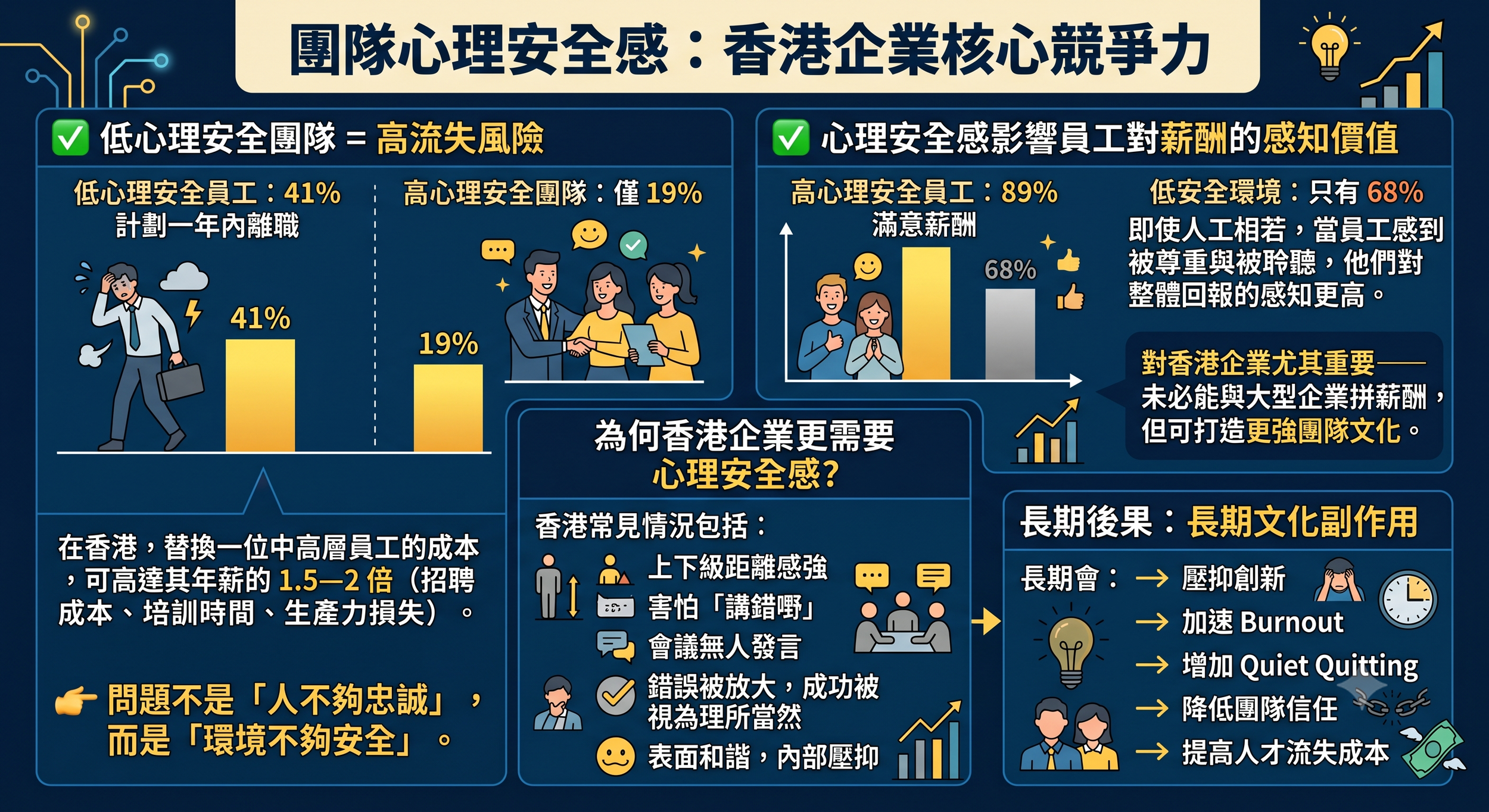
41% 低心理安全員工計劃一年內離職
高心理安全團隊僅 19%
在香港,替換一位中高層員工的成本,可高達其年薪的 1.5–2 倍(招聘成本、培訓時間、生產力損失)。
👉 問題不是「人不夠忠誠」,而是「環境不夠安全」。
Source: The American Psychological Association’s 2024 Work in America Survey
✅ 心理安全感影響員工對薪酬的感知價值
89% 高心理安全員工滿意薪酬
低安全環境只有 68%
即使人工相若,當員工感到被尊重與被聆聽,他們對整體回報的感知更高。
這對香港企業尤其重要——
因為你未必能與大型企業拼薪酬,但你可以打造更強的團隊文化。
為何香港企業更需要心理安全感?
香港常見情況包括:
上下級距離感強
害怕「講錯嘢」
會議無人發言
錯誤被放大,成功被視為理所當然
表面和諧,內部壓抑
這種文化短期看似有效率,長期卻會:
壓抑創新
加速 Burnout
增加 Quiet Quitting
降低團隊信任
提高人才流失成本
高心理安全團隊的商業優勢
當團隊具備心理安全感:
✅ 員工更敢提出創新建議
✅ 更願意承擔責任
✅ 更快暴露問題,減少重大風險
✅ 提升跨部門協作
✅ 增強管理層信任度
這不是「軟性 HR 活動」,而是提升企業盈利能力的策略性投資。
行動方案:立即提升團隊心理安全感
國際認證課程(適合 HR / 領導者/COACHES)📢 最新消息!下期課程現正接受報名:
第五期(英文授課)
💻 2026年6月15日、22日、29日及7月6日(星期一,上午9:30至中午12:30)網上課堂
第六期(粵語授課)
📍 2026年8月8日(星期六,上午9:30至下午5:30)實體課堂
💻 2026年8月15日及22日(星期六,上午9:30至中午12:30)網上課堂
現在,是你提升團隊競爭力的最佳時機。
👉 報名國際認證課程
建立真正高績效、可持續的團隊文化,
從心理安全開始。